?ts=1745422095316&dpr=off)
Miniaturization is a top priority for all kinds of designs—from tech gizmos to medical equipment. Electronics are often the focus of miniaturization efforts, but mechanical parts also need to shrink.
This is no small challenge (pun intended). As space is squeezed, parts need to retain strength even though their dimensions shrink. Complex geometries become harder to fabricate even as tolerances get tighter. All this while costs and time-to-market need to be kept to a minimum.
Many engineers might think of machining or investment casting or even powder metallurgy as a way to produce such parts. But there’s a long existing process that for some unknown reason many university engineering departments overlook: metal injection molding, otherwise known as MIM.
That is a shame, because it is well suited for manufacturing of complex smaller pieces in a process that is familiar to anyone who has designed for plastic injection molding.
MIM can deliver superior end products with resulting excellent surface finish, superior corrosion resistance, and high strength. All this happens with a single-mold process that supports complex contours and geometries, holes, small radii, logos and text. MIM also delivers impressive financial savings, running investment casting.
The approach is similar to how some craftspeople make jewelry out of metal clay, which is a combination of semi-precious metal power and a polymer clay. Mixed together, the artisan can then shape the result, perhaps with a mold, into whatever they wish.
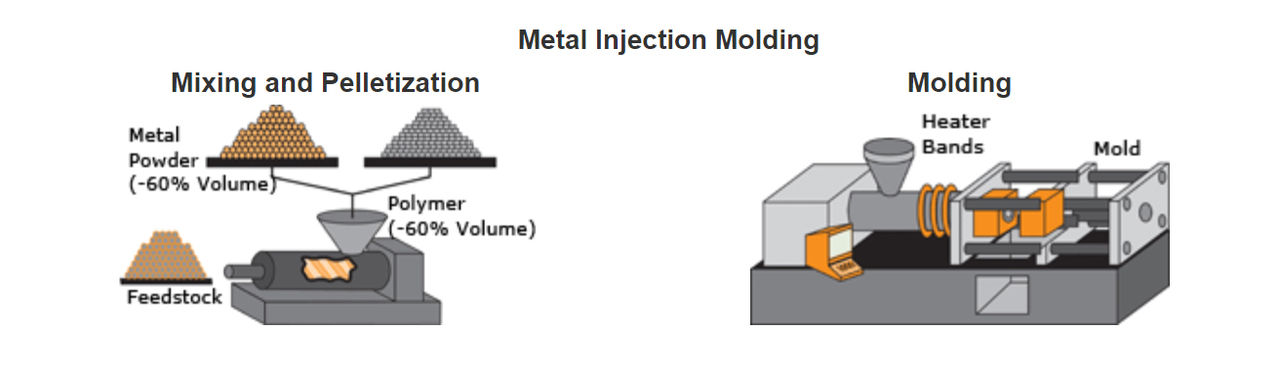
MIM is more complex in its execution, but is essentially the same. It uses a combination of metal powder and a polymer binder in a roughly 60:40 ratio. Under heat, the powder and binder are turned into a uniform mix and then allowed to cool. The result is granulated, becoming the feedstock for molding.
Potential metals include stainless steels (17-4, 316, 420); low carbon steels (FN02, FN0205, FN08, 4620, 4140, 8620); soft magnetics (FeSi3, FN50); and tool steels, controlled expansion alloys, or high temperature alloys.
This is a process best suited for small end products or parts; the rule of thumb is that they should be smaller than a tennis ball or racquet ball. Walls should be uniform and between 0.030 inches to 0.250 inches in thickness. Normal manufacturing tolerances are 0.5%, but if tighter tolerances are critical, it is possible to make some aspect of a part slightly oversized and then machine it down.
Here are some of the competitive advantages that MIM can provide:
- Over machining — Less weight, harder steels possible, part consolidation as more complex single parts are possible, lower cost, and fewer steps.
- Over investment casting — Thinner wall sections, better surface finish, less secondary machining, smaller holes possible, and higher volumes on shorter lead times.
- Over powder metallurgy — Greater part complexity, thinner wall sections, part consolidation, higher density, higher strength, and better corrosion resistance.
The pre-production design steps are similar to what you might expect with plastic injection molding, with initial design, check for manufacturability, mold design, initial sampling, and so on.
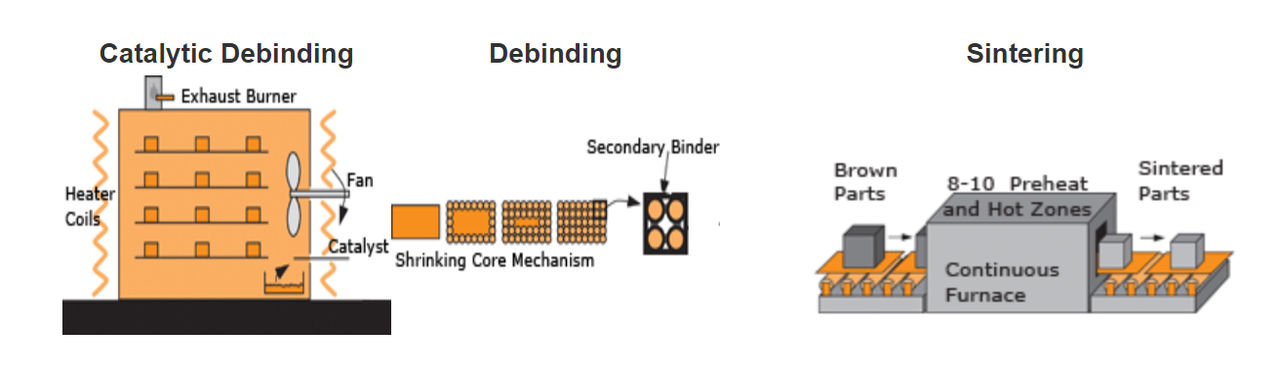
The MIM process itself, after creating the feedstock, is straightforward with molding, two stages of debinding, and then sintering.